The Department of Labor’s Wage and Hour Division in the Southwest Region held a virtual workshop in June on “Cultivating Compliance in Agriculture Workplace”. Representatives from multiple departments presented on timely topics from H-2A visa processing and wage protections to avoiding immigration-related employment discrimination and understanding the intricacies of the Migrant and Seasonal Agricultural Worker Protection Act (MSPA). The recording of the half-day webinar is available here.
Below, we highlight key insights and updates from each agency’s presentation—including recent announcements and upcoming changes that producers and labor providers should have on their radar.
Department of Justice
The Department of Justice/Civil Rights Division/Immigrant and Employee Rights Section had a presentation on “How to Avoid Immigration-Related Employment Discrimination”. They shared some recruitment best practices to ensure that there is no national origin discrimination. One of the most important practices is to broadly advertise all types of available positions to all categories of qualified workers regardless of citizenship status and to avoid making blanket assumptions for categories of potential employees.
8 U.S.C. § 1324b prohibits discrimination based on citizenship status and national origin in hiring, firing, and recruitment practices. Specifically, it makes it illegal for employers to discriminate against individuals in these areas, ensuring that both American workers and work-authorized immigrants are protected. This extends to the Authorization to Work verification process. Employers are required to complete either the I-9 or E-Verify processes; however, they are prohibited from making unfair document requests. It is unlawful for employers to request more than what is required to verify status or identity, according to the DOL representative. This, of course, can be complicated in a rapidly evolving environment. Additionally, the law prohibits retaliation or intimidation against individuals asserting their rights as described in the law.
Department of Labor
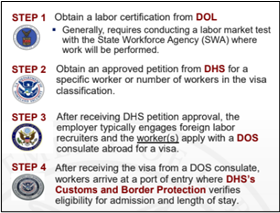
The Department of Labor/Employment and Training Administration/Office of Foreign Labor Certification gave an overview of the use of the “H2A Worker Program”.
The presentation also included information on the mechanics of using the Foreign Labor Application Gateway (FLAG) and the PERM Case Management System.
The Office of Foreign Labor Certification also described the steady increase of worker visa applications, including farm labor through H2A, from 130,289 in 2010 to 411,950 in 2024. Florida, Georgia, California, Washington, and North Carolina remain the destinations with the largest number of foreign workers.
Finally, the DOL briefly discussed the history of the Adverse Effect Wage Rate, established through 8 USC 1188(a)(1)(B). DHS cannot grant admission unless DOL determines that employment of H-2A workers will not adversely affect the wages and working conditions of U.S. workers similarly employed.
Note from SESO Labor: The DOL announced on July 10, 2025 that the Agency will publish the new OEWS Adverse Effect Wage Rates (“AEWR”) in the July 11 Federal Register, which will go into effect for employers on either 07/11/2025 or 07/25/2025, depending on the state of employment.
Department of Labor/Wage and Hour Division
DOL also provided an overview of the Migrant and Seasonal Agricultural Worker Protection Act (MSPA) systems and related forms (Forms WH-530, WH-535, and WH-540). Inquiries about MSPA can be directed to (415) 241-3505.
On the date of the presentation, 10,116 Farm Labor Contractors held a valid certificate, 1,602 FLCs had transportation authorization, 589 FLCs had housing authorization, and 11,052 FLC employees had driving authorization.
Department of State/Monterrey Consulate
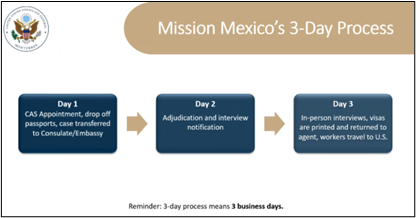
The US Embassy to Mexico (Mission Mexico) realigned its H2 processing capacity in FY 2025. They moved more of the function to the Consulate in Monterrey and they anticipate a 14% higher capacity for H2 appointments in FY 2025 than they had in FY 2024. They maintain a three-day model and anticipate they’ll have the capacity to meet H2 demand.
The US Embassy works with the Mexican government. A presentation from the Servicio Nacional de Empleo (SNE) which is housed within the Secretaría de Trabajo y Previsión Social was also made available: “National Empolyment Service.pdf”
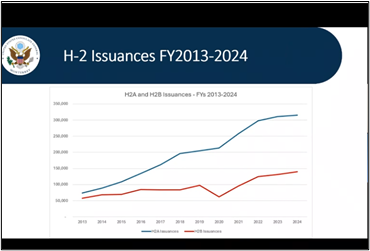
Although the number of foreign workers from Central America has increased in recent years, the vast majority of H2 applicants have Mexico as their country of origin, as indicated by Mission Mexico’s H2 annual workload.
Workshops like this one offer valuable insights to help employers uphold compliance, protect workers, and plan with confidence. As the agricultural labor landscape continues to evolve, staying informed and engaged with agency guidance is critical. To stay in the know, sign up for our newsletter: https://aaalp.org/contact/
